
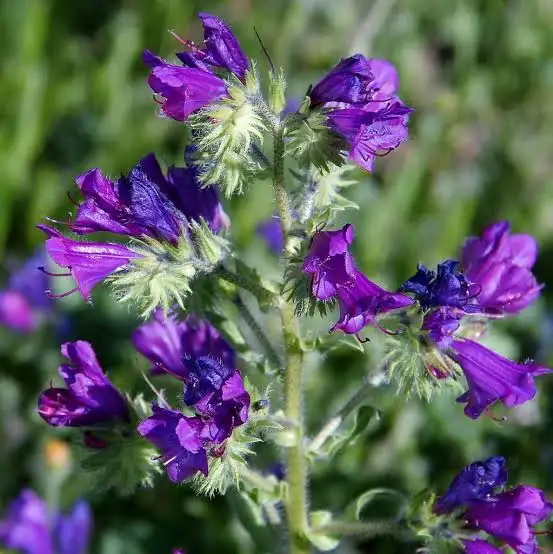
Paterson’s curse is an annual, occasionally biennial, herb that grows as a rosette in autumn and winter and produces flowering stalks in spring and early summer. The rosette usually grows parallel to the ground, however the leaves may be erect in dense vegetation.
Stems
The stems of Paterson’s curse are stout, erect and commonly 30 to 60cm tall, but often taller (rarely to 2m). They are light-green in colour and densely covered with coarse bristles. Stems branch mainly towards the top — often several stems emerge per plant.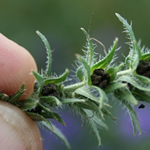
Leaves
Paterson’s curse leaves are green to light-green, alternate, thick and densely covered with soft or bristly hairs. Basal (rosette) leaves are up to 30cm long, are shortly stalked, elliptical-to-oval or paddle-shaped and conspicuously veined. These leaves die off as stem growth increases.
Stem leaves are smaller, strongly haired, stalkless, oblong-to-lance-shaped and heart-shaped at the base, almost clasping the stem.
Flowers
The flowers of Paterson’s curse are located in curved terminal clusters and are funnel-shaped. They are usually purple but may be blue, pink or, rarely, white.
The flowers have a calyx of 5 bristly, linear-to-lance-shaped sepals, are 8 to 11mm long, elongating to 15mm in the fruit. The petal tube may be 20 to 30mm long with 5 stamens, 2 of which are longer than the other 3 and protrude from the petal.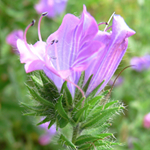
Fruit
Paterson’s curse plants produce four nutlets, surrounded by the persistent, stiff, bristly calyx.
Seeds
The seeds of Paterson’s curse are dark brown to grey and tough, angular and beaked. They are up to 3mm long and 2mm wide, are three-sided, strongly wrinkled and pitted.
Roots
Paterson’s curse roots consist of a stout tap-root with numerous laterals.